|
|
|

April 2011 - Aquatic Therapy: An alternative to traditional land-based therapy, by James Randolph PT
|
April 2011 - Aquatic Therapy - An alternative to traditional therapy.
|
|
Aquatic Physical Therapy
Physical Therapy has been recognized as a vital component in the successful rehabilitation of a variety of musculoskeletal disorders. However, there may be times when a traditional land based rehabilitation program may prove too challenging for individuals suffering from a diagnosis such as osteoarthritis. Aquatic therapy can prove to be a successful alternative for these individuals.
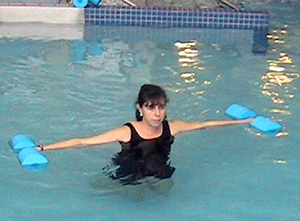 Several properties of water including buoyancy, hydrostatic pressure and warm temperature can aid in improving joint range of motion, muscle flexibility, strength and recovery of function. Water buoyancy decreases weight bearing through the lower extremities allowing increased tolerance to joint motion and strengthening activities from a standing position. Several properties of water including buoyancy, hydrostatic pressure and warm temperature can aid in improving joint range of motion, muscle flexibility, strength and recovery of function. Water buoyancy decreases weight bearing through the lower extremities allowing increased tolerance to joint motion and strengthening activities from a standing position.
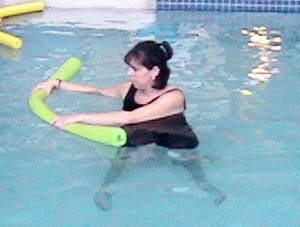 Standing waist height in a standard pool, individuals typically can offset body weight up to 54%, and at the level of the upper arm 70%. Thus allowing increased tolerance to exercises in standing. As tolerance to weight bearing improves exercises can be progressed to more shallow water. In addition to buoyancy, hydrostatic pressure exerted by water submersion can assist in the management of swelling and edema that individuals may experience in response to exercising. Standing waist height in a standard pool, individuals typically can offset body weight up to 54%, and at the level of the upper arm 70%. Thus allowing increased tolerance to exercises in standing. As tolerance to weight bearing improves exercises can be progressed to more shallow water. In addition to buoyancy, hydrostatic pressure exerted by water submersion can assist in the management of swelling and edema that individuals may experience in response to exercising.
 The water temperature of the pool also has its advantages. The warm water therapy pool at St. James Health and Wellness typically ranges between 94° and 96°F. Most patients in our aquatic program feel the warm water provides a more relaxing environment for their joint pains and limited movements. The increased temperature can assist in increasing range of motion, and muscle flexibility. Though certain precautions must be taken in the water, supervised aquatic therapy may be a preferred alternative to traditional land based rehabilitation. The water temperature of the pool also has its advantages. The warm water therapy pool at St. James Health and Wellness typically ranges between 94° and 96°F. Most patients in our aquatic program feel the warm water provides a more relaxing environment for their joint pains and limited movements. The increased temperature can assist in increasing range of motion, and muscle flexibility. Though certain precautions must be taken in the water, supervised aquatic therapy may be a preferred alternative to traditional land based rehabilitation.
|
February 2011 - Carpal Tunnel Symptoms at Night, by Barbara Shoemaker OT, CHT
February 2011 - Carpal Tunnel Syndrome
|
|
Why do Carpal Tunnel Syndrome symptoms seem to worsen at night?
People with Carpal Tunnel Syndrome initially feel numbness and tingling of the hand due to compression on a nerve running through bones and other structures in the wrist. These sensations are often more pronounced at night and can awaken people from sleep. The reason symptoms are worse at night may be related to a bent-wrist sleeping position creating increased pressure on the median nerve. It is important to sleep in a wrist brace that holds your wrist straight. Many over-the-counter wrist braces will help but the metal stay should be straightened for optimal positioning as most OTC braces come with too much of an angle. Studies have shown this prefabricated angle actually increases the amount of pressure on the already compressed nerve. Waking due to pain and tingling can also be a result of inactivity during sleep. Blood vessels normally open up and dilate at night leading to increased fluid accumulation within the carpal tunnel. Normal movements usually will help pump out the extra fluid, but as movement doesn't usually occur during sleep, the inactivity can lead to increased symptoms. Should you continue to experience increased carpal tunnel symptoms at night, you may need to make an appointment with your doctor to discuss treatment options. Treatment options may consist of wearing a hard splint instead of a brace, oral steroids, occupational therapy or surgery. |
January 2011 - Effects of Weather on Body Pain, by Ray Letke PT, ATC
|
January 2011 - Effects of Winter Weather on Body Pain |
|
Could the cold weather be a pain in your.....?
Many patients have told me that a storm is approaching because they can feel it in their joints. Is the weather the cause of the increase in their symptoms or is it a figment of their imagination? A doctor or therapist cannot measure the intensity of pain a patient is experiencing. However, pain is certainly very real and it affects patient’s emotions and attitude. So when weather reaps havoc on my patients, I tend to listen. Is this some myth, or is their some climate change that physiologically affects the human body?
There are a considerable number of published reports that accept the idea that weather has some kind of influence on us. According Dr. Timothy McAlindon, MD, Associate Professor of Medicine and Chief of the Division of Rheumatology at New England Medical Center, in Boston, Massachusetts, “it is well accepted that barometric pressure can have physiological effects.”
Weather sensitive pain is a result of the reaction on our Sympathetic Nervous System. This system monitors for injury of the soft tissues in the body and also regulates functions such as heart rate, blood vessel constriction, swelling and sweating. As the barometric pressure changes (up or down), fluid begins to fluctuate in the joints, causing more pressure, resulting in swelling and pain. Patients that have recently undergone surgery or suffer from arthritis are sensitive to this pressure fluctuation and experience symptoms such as stiffness, soreness and achiness.

Don’t let the weather get you down. There are some things you can do to help alleviate your pain. Experiment with heat or cold, approximately 15-20 minutes at a time, to relieve pressure and pain. Regular exercise, stretching, and cardiovascular conditioning can help prevent pressure changes by decreasing fluid viscosity that can cause stiffness and discomfort.
Should a friend of yours that suffers from joint pain complain that their knees ache, I would bet that a storm is soon approaching. They may be a bit more accurate than your local weatherman.
|
|
|
©2013
|